20482 is tyttoot's version of 2048, the sliding number puzzle, dressed up as a star forge: the tiles are rune stones on a stone altar, and merging two of them "forges" a bigger one. The rules are the classic ones. What makes it more than a reskin is that it has three modes with different boards and goals, plus a per-mode leaderboard called the Star Chart.
We played all three modes in the web version on 17 October 2026, in a 1280×800 desktop window with the arrow keys. This guide explains how the modes differ, what the screens mean, and what went wrong in our runs, because each run stalled for a reason you can avoid.
The rules, forge-style
The in-game Guide puts it well: swipe (or press an arrow key) and every stone on the altar slides as far as it can in that direction. Two stones with the same number that touch fuse into one stone worth their sum, and that value is added to your score. After every move a new 2 or 4 appears. When no stone can move, "the forge cools" and the game ends.
Each value has its own look, which helps once you learn it: grey 2s, cream 4s, brown 8s, orange 16s, red 32s and 64s, gold 128s and a teal 256. The guide shows the ladder continuing through blue 512s up to the white 2048 Star Core, and says you can keep going past it to nebula, obsidian and prism stones.
The three forge modes
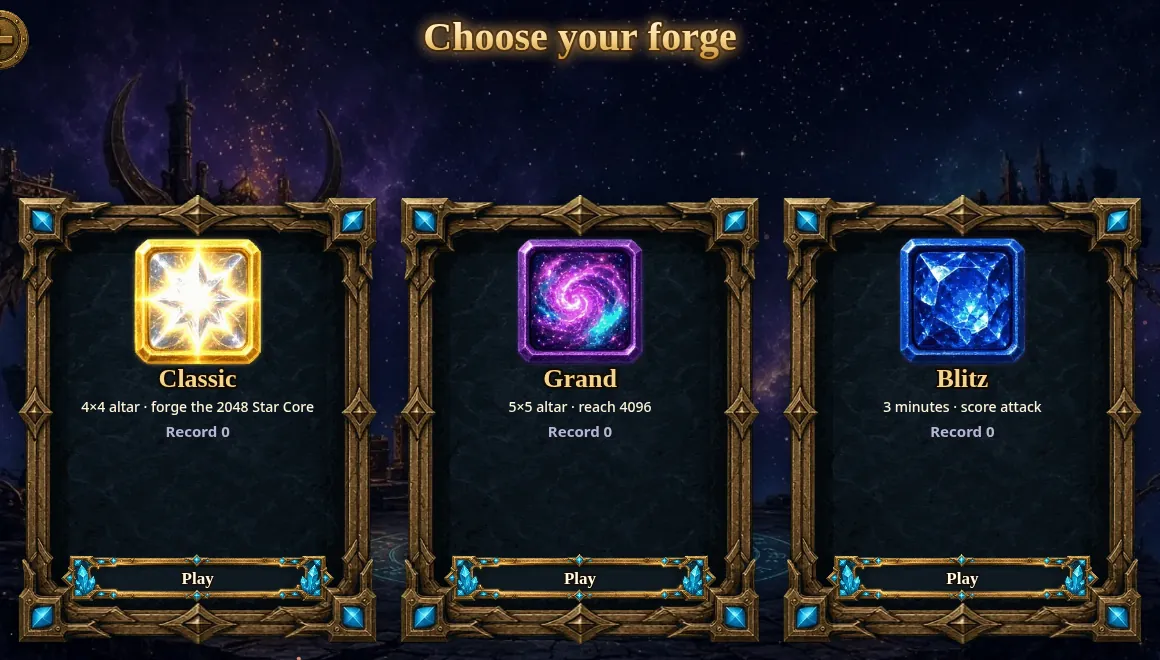
Tap Start, then Forge, and you get three cards:
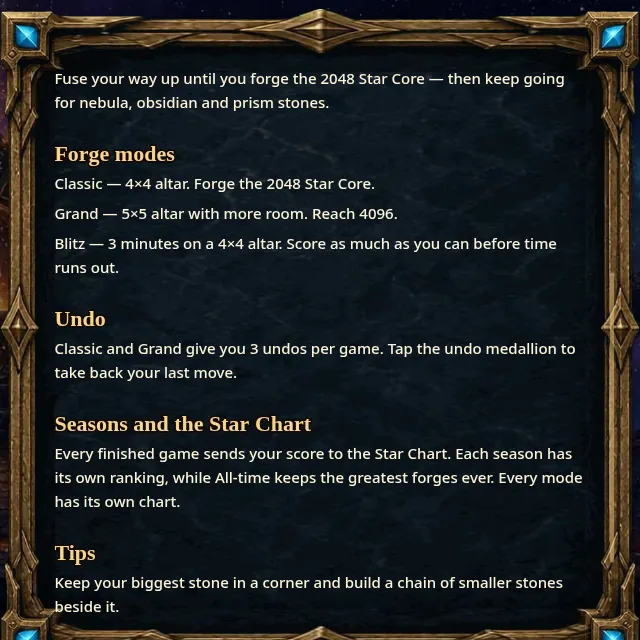
| Mode | Board | Goal | Undo |
|---|---|---|---|
| Classic | 4×4 | Forge the 2048 Star Core | 3 per game |
| Grand | 5×5 | Reach 4096 | 3 per game |
| Blitz | 4×4 | Score as much as you can in 3 minutes | none |
The undo medallion sits in the top-right corner of the board screen with a small counter showing how many you have left. It takes back your last move. We did not use it in any of our runs.
How we played
To keep the three runs comparable, we used the same simple plan in every mode, the one most 2048 guides start with: press Down whenever it moves something, otherwise Left, otherwise Right, and Up only when nothing else works. The aim is to keep the biggest stone pinned in the bottom-left corner. It is a decent baseline. It is also exactly the plan the game's own tips hint at, and our results show where it runs out.
Classic: a 256 in the corner, walled in by a 2
Our Classic run ended at 3,052 points with a 256 as the highest stone. Near the end the board looked like this:
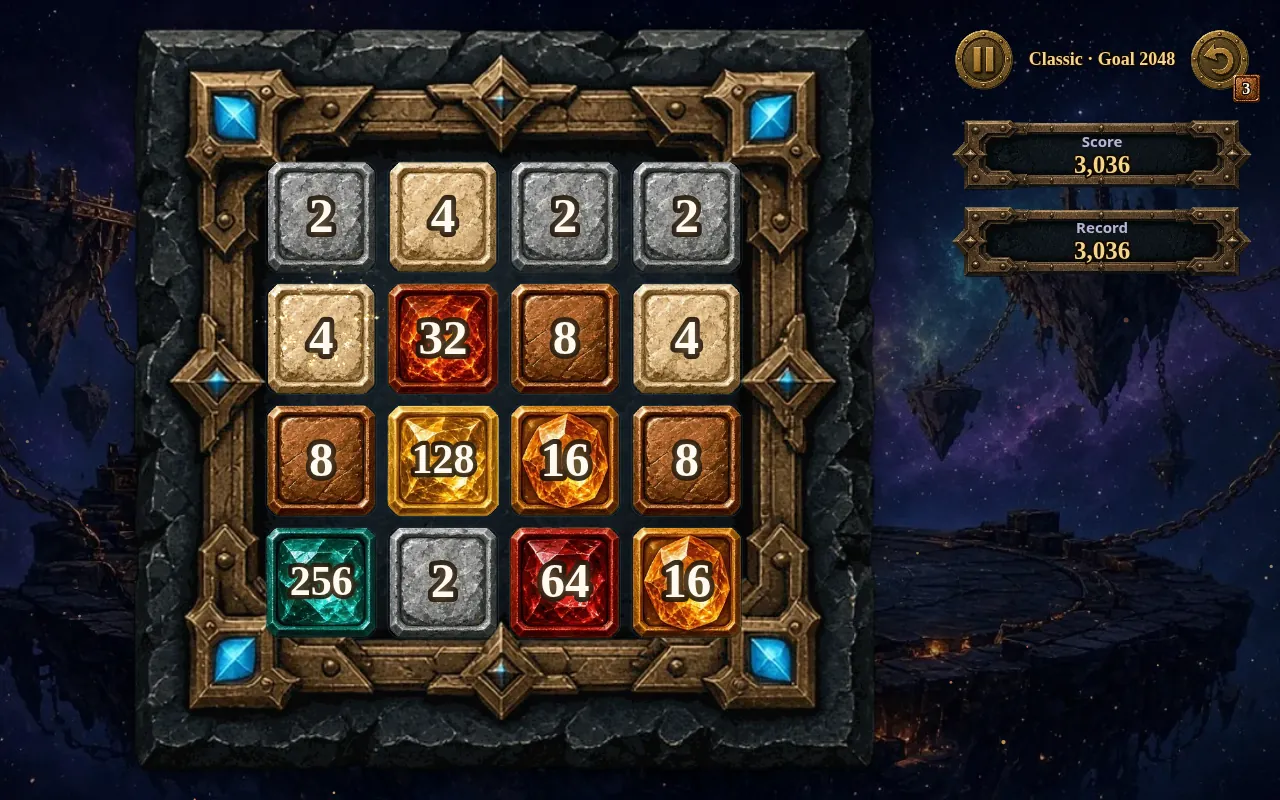
The corner plan worked in the sense that the 256 stayed in the corner. The problem is the 2 next to it. A big stone only grows if the stones beside it climb towards it in order (256, 128, 64, 32…), so the next merge can happen right next to it. Here, a new 2 got into the bottom row, most likely during one of the forced Right or Up moves, the 128 ended up one row higher, and the board filled before we could fix the order.
Grand: more room, same mistake in a bigger space
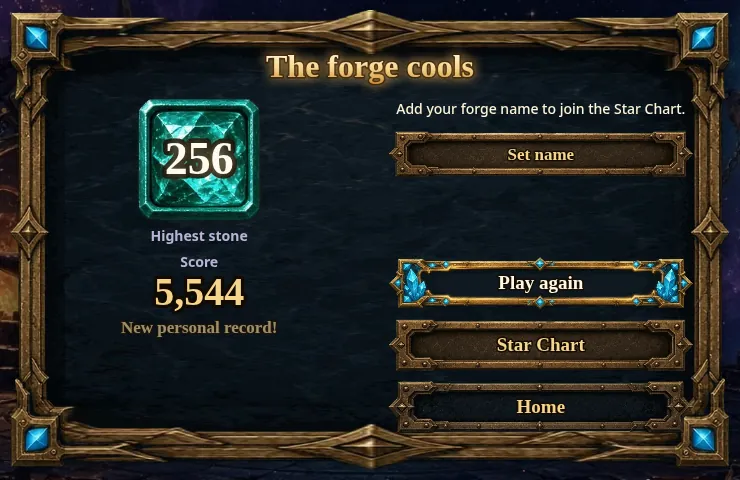
Grand's 5×5 altar gives you 25 squares instead of 16, so the board fills more slowly. Our Grand run scored 5,544 points, but the highest stone was again a 256.
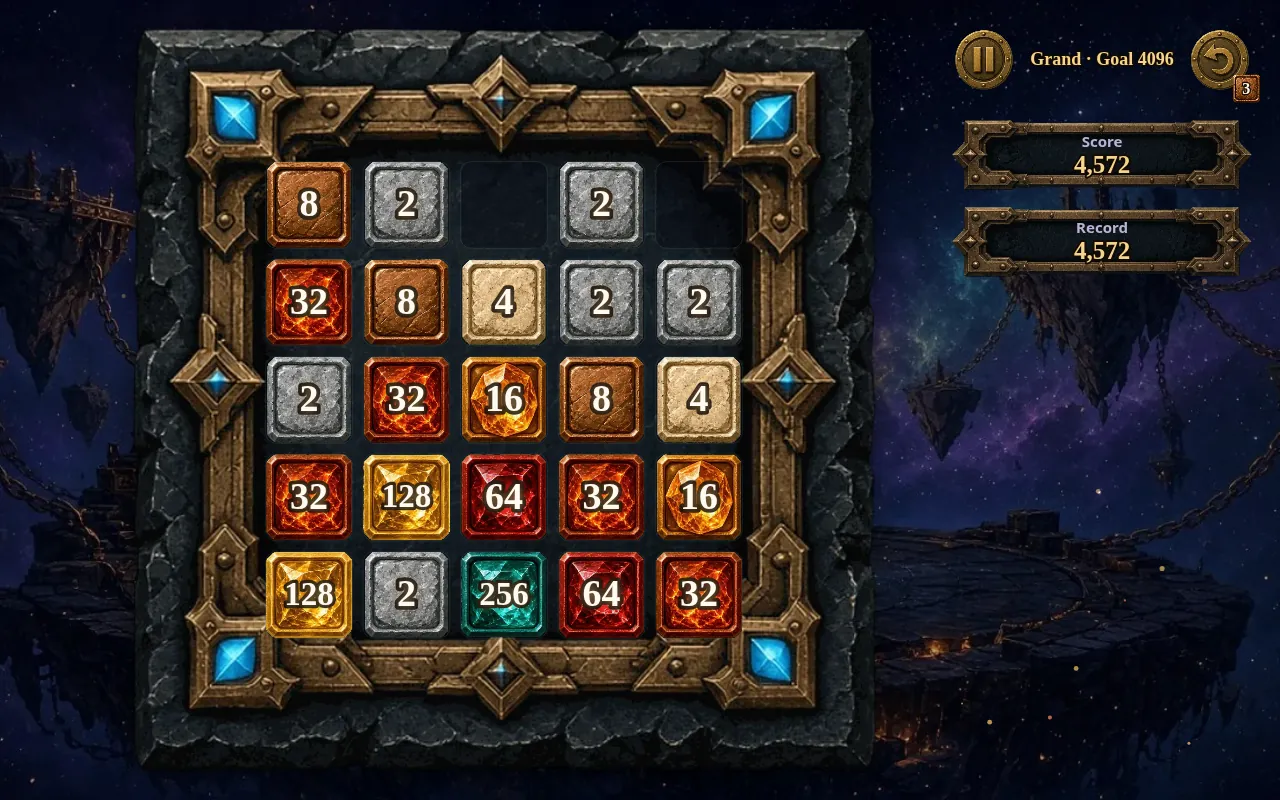
The screenshot shows why. The 256 drifted to the middle of the bottom row, and our two 128s were not next to each other (one in the bottom-left corner, the other a row up in the second column), so they could not merge. On a larger board it is easier to end up with duplicates of your big stones far apart. More room means more time, not an easier game.
Blitz: the board, not the clock, ended it
Blitz gives you three minutes on a 4×4 altar and no undo. The timer sits under the score:
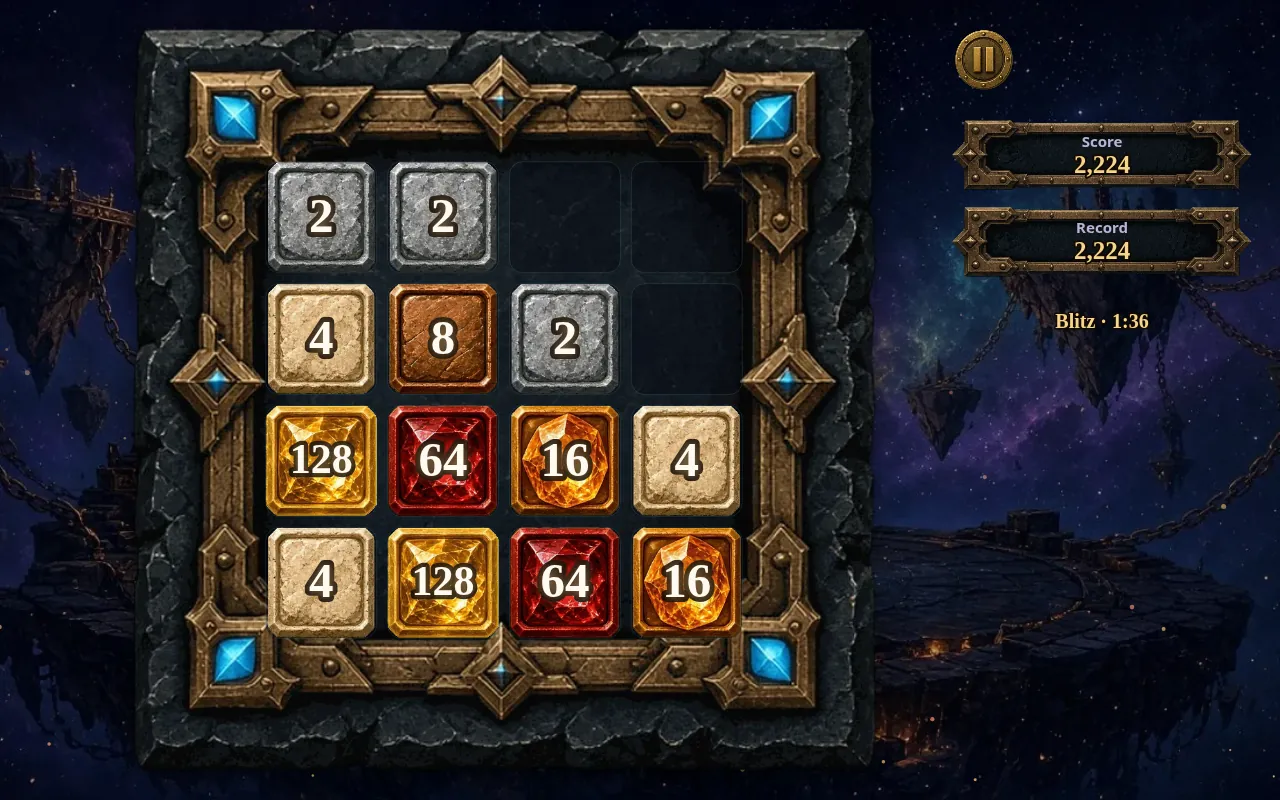
Our Blitz run finished at 2,772 points with a 128 as the highest stone, and it did not end on time. The board locked up with roughly 50 seconds still on the clock. The screenshot at 1:36 shows the cause: two 128s and two 64s spread around the bottom rows. Playing fast with the same fixed plan made the board messy sooner. The game's own Blitz tip, "quick small merges beat slow perfect plans", is about scoring, but you still have to leave yourself somewhere to move.
The Star Chart
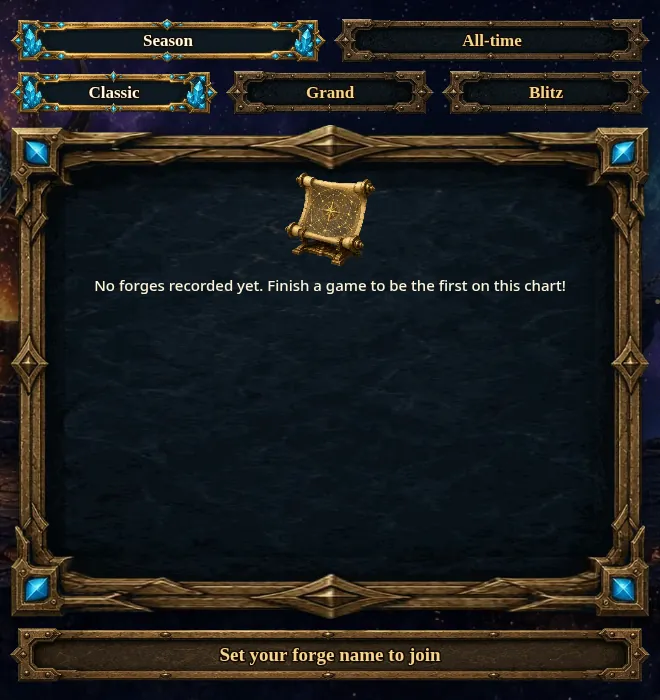
Every finished game can go on the Star Chart, which has a tab per mode and a choice between Season (rankings for the current season) and All-time. You need a forge name first: the result card has a Set name button. We did not set one, so our runs are not on the chart.
Tips that would have saved our runs
- Corner plus order, not just corner. Keep the biggest stone in a corner, and keep the row next to it in descending order: 256, 128, 64, 32. A small stone sitting next to your biggest one is the warning sign; fix it before anything else.
- Avoid the move that pulls your big stone out of its row. In our plan that was Up. When you are forced to use it, follow up straight away with Down so the gap fills from your side.
- Never let two big twins drift apart. If you have two 128s, getting them together is the priority. In Grand especially, check the whole board before you move.
- Use the undo in Classic and Grand. Three undos are exactly what you need for the moment a 2 lands next to your biggest stone. We left all three unused; you shouldn't.
- In Blitz, merge small stones fast but keep a direction in reserve. Score comes from lots of merges, but a locked board ends the run as surely as the clock does.
Who it is for
If you already like 2048, 20482 gives you a nicer-looking altar, three ways to play and a season leaderboard to aim at. If you are new to it, start with Grand: the extra row and column give you time to learn how stones line up before a 4×4 board punishes every mistake.