Chongyang, the Double Ninth Festival, falls on Sunday 18 October 2026. It is a day for visiting elders, and in many Chinese and Vietnamese families that means a board of Xiangqi (Chinese chess, cờ tướng) on the table. If you want to brush up before sitting down with a grandparent, or you want a board ready on a tablet, Saint Chess is tyttoot's Xiangqi game. It runs in a browser and also has an iPhone, iPad and Mac version.
We played it on desktop on 15 October 2026 against the Easy AI. This guide covers what the app offers, then walks through our first three moves, including the mistake that cost us a horse.
What is in Saint Chess
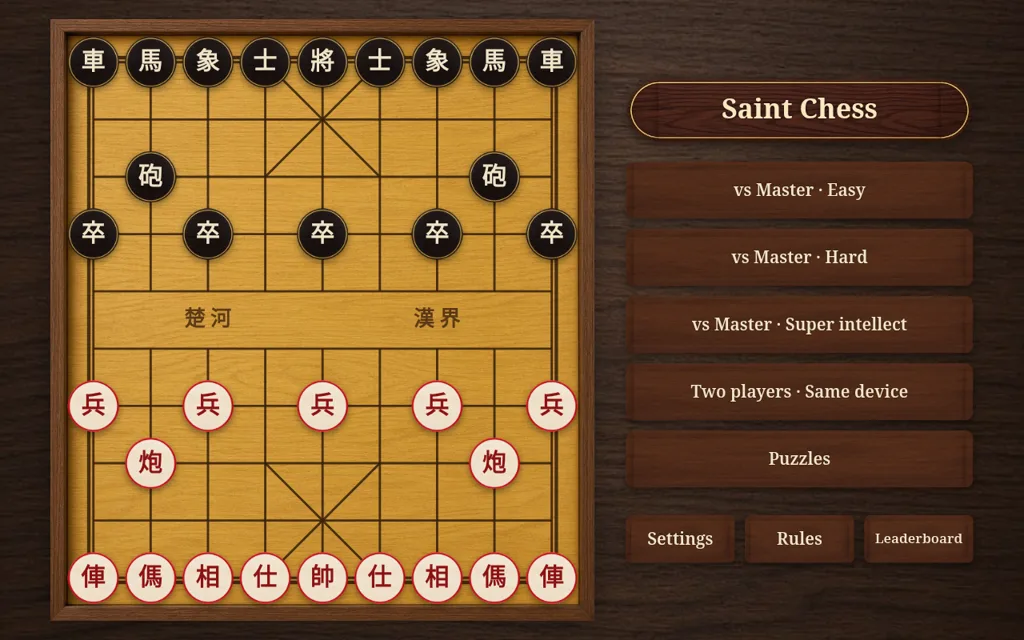
- vs Master (Easy, Hard, Super intellect): "Master" is the computer opponent, an AI, not a person. The Rules screen explains that Super intellect is a deeper local search, not a cloud service.
- Two players · Same device: two people share one screen, and the board keeps the same orientation, which suits a grandparent and grandchild sitting side by side.
- Puzzles: set positions to solve.
- Leaderboard: season points from games against the AI.
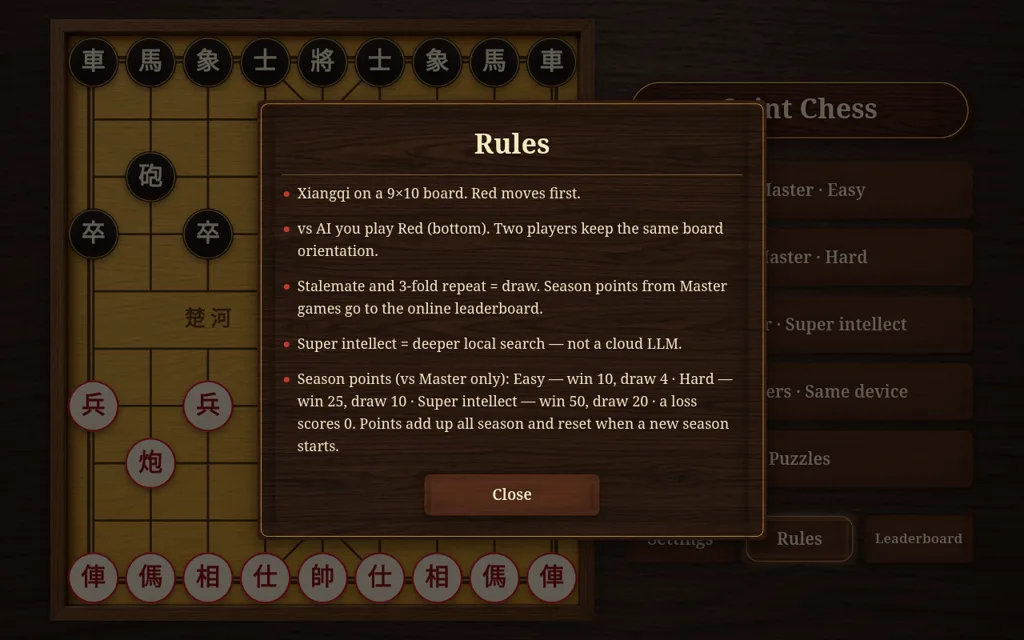
Against the AI you always play Red at the bottom, and Red moves first. A win is worth 10 season points on Easy, 25 on Hard and 50 on Super intellect, a draw is worth 4, 10 or 20, and a loss scores nothing.
The pieces in one minute
The pieces are labelled in traditional Chinese characters, with different characters for Red and Black.
| Piece (Red / Black) | Moves |
|---|---|
| General 帥 / 將 | one point orthogonally, inside the 3×3 palace |
| Advisor 仕 / 士 | one point diagonally, inside the palace |
| Elephant 相 / 象 | exactly two points diagonally, cannot cross the river, blocked if the middle point is occupied |
| Horse 傌 / 馬 | one point straight, then one diagonally outward, blocked if the first point is occupied |
| Chariot 俥 / 車 | any distance orthogonally, like a rook |
| Cannon 炮 / 砲 | moves like a chariot, but captures only by jumping over exactly one piece (the "screen") |
| Soldier 兵 / 卒 | one point forward; after crossing the river it may also step sideways |
The two generals may never face each other on an open file. That rule decides many endgames.
Our first game: three moves, one lesson
Move 1: central cannon. We opened with the most common first move, sliding the right cannon to the centre file (炮二平五), aiming straight at Black's central soldier and general. The Easy AI answered by pushing its central soldier one step.
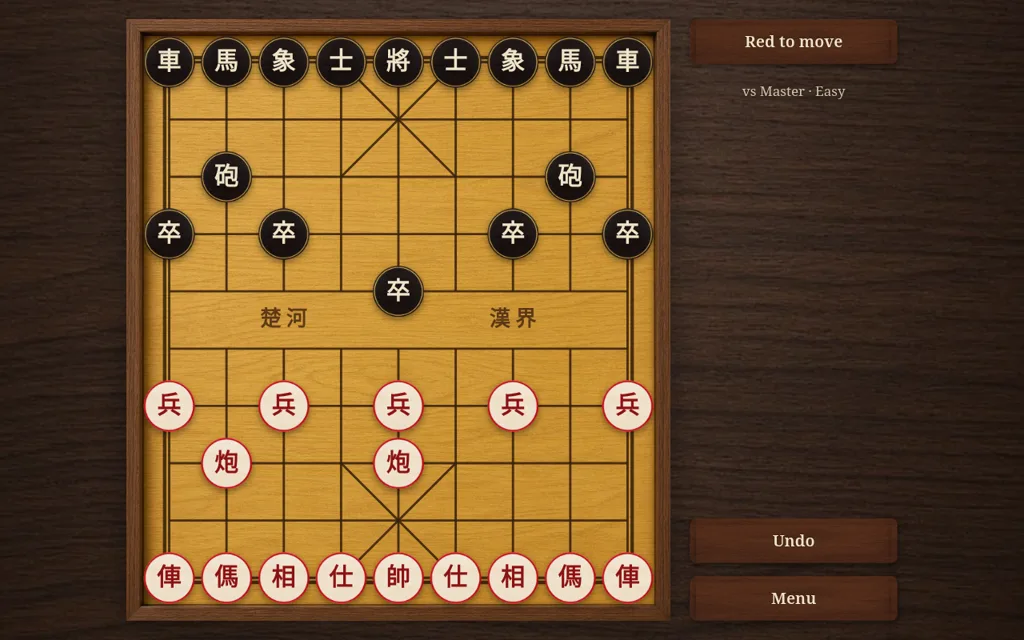
Move 2: right horse out. We brought the right horse up in front of the elephant to support the centre. Black pushed another soldier.
Move 3: the mistake. We moved the right chariot one step toward the centre. That looked harmless. But look at the left side of the board: our left cannon was still on its starting point, in the same file as our left horse, with nothing else between Black's cannon and us. Black's cannon slid down that file, used our own cannon as its screen, jumped over it and took the horse on our back rank.
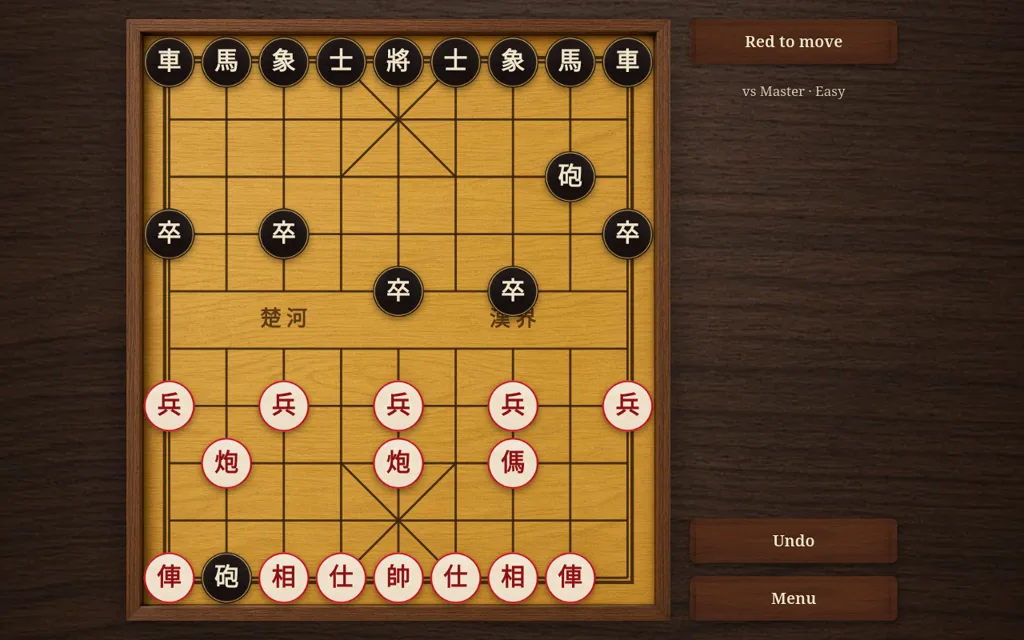
The lesson is a classic one and worth teaching any beginner: a cannon needs a screen, and your own pieces count. If one of your cannons sits directly in front of an undefended piece on an open file, the opponent's cannon on that file is already attacking it. In practice:
- Develop both horses early. Bringing the horse up in front of its elephant also protects it.
- After every move, check each open file for a cannon with exactly one piece between it and something of yours.
- Use Undo (the button beside the board) to replay a position on Easy and see the threat for yourself. That is how we confirmed what had happened.
Making it a Chongyang activity
- If a grandparent already plays, try Two players · Same device and let them teach on the screen. The Undo button makes it easy to show "what if" lines.
- If you are both learning, play vs Master · Easy together and talk through each move before tapping.
- Puzzles are short, which suits a visit where everyone is chatting.
Chinese-language versions of this guide are planned for the festival window. We are publishing in English first while the site's Chinese interface is still being prepared.